Best PugglePay Online Casinos, PugglePay Casino Sites (2026)
PugglePay is a name older Scandinavian casino players may still recognise, but it is not a payment method I would expect to find in an active casino cashier today. The service started in Sweden in 2012 and was built around simple mobile payments using a phone number. Its early invoice model became particularly associated with online gambling because players could make a casino deposit first and settle the payment afterwards.
That setup made PugglePay quite different from a normal debit card or e-wallet. Players did not need to enter card details into the casino, and the deposit could be confirmed through a mobile number and SMS code. Once approved, the casino balance was normally credited immediately.
PugglePay became best known in Sweden and later expanded into Finland as the company pushed further into Nordic mobile payments. The business eventually changed direction and the PugglePay name was replaced by Zimpler. Today, Zimpler is the active payment brand, while PugglePay belongs to an earlier stage of the company's history.
That means I would be suspicious of any casino currently claiming to offer a genuine standalone PugglePay cashier in 2026. Old casino directories still list the name, but that does not mean the payment system itself remains operational.
For players looking for the modern equivalent, Zimpler is much more relevant. Its present payment product works very differently from the old PugglePay invoice model, so the two should not be treated as interchangeable payment methods.
How I Would Judge Casinos Still Listed As PugglePay Casinos
Rating PugglePay casinos today needs a different approach because the payment service itself is historical. I would not build a current ranking simply by finding casino pages that still contain the PugglePay name. Old banking pages are frequently left online long after payment integrations disappear, and an outdated payment logo tells me very little about what is actually available in the cashier.
There are also casino comparison sites that continue to show PugglePay casinos despite the original payment service having been replaced. For that reason, I would verify the live cashier and treat a casino claiming current PugglePay support with caution.
These are the points I would use when assessing such casinos:
The payment option must actually exist in the live cashier. This is the first check. A PugglePay mention in an old review or banking guide is not enough, especially now that the standalone service is gone.
Deposits and withdrawals need to be explained accurately. Historical PugglePay was a deposit method rather than a normal two-way withdrawal service. If a casino claims direct PugglePay withdrawals today, I would want very strong evidence before trusting that statement.
No unexplained payment commission. Old PugglePay deposits involved invoice terms rather than a standard wallet fee structure. A casino adding its own mystery transaction charge would make the method less attractive.
Withdrawal alternatives should be fast and clearly listed. Since PugglePay did not provide a normal casino withdrawal route, the operator needed another method for paying winnings. Bank transfer or another supported payment service should be available without unreasonable restrictions.
The casino must have a good reputation. I look for patterns involving unpaid withdrawals, confiscated balances, fake bonus terms and poor support. Old or obscure payment pages are sometimes a sign that the casino itself has not been maintained properly.
I verify the gambling licence. A casino should have licence information that matches the regulator's records. A payment-provider logo cannot substitute for a valid operating licence.
The website needs HTTPS protection. Casino login and cashier pages should encrypt information sent between the player and the site. That requirement does not change just because the payment method uses a phone number rather than a card.
Support needs to understand its own cashier. If an operator still mentions PugglePay, customer support should be able to tell players whether it actually works or has been replaced. An agent who cannot answer that simple payment question would lower my confidence quickly.
KYC should be straightforward. Identity checks should have clear document requirements and sensible processing times. PugglePay's old phone verification never removed the casino's own responsibility to verify players where required.
Bonuses need proper payment terms. If an old page says PugglePay deposits qualify for a bonus, I would confirm that the promotion and payment method still exist. Outdated promotion pages are surprisingly common.
The game selection still matters. Even a good banking setup means little when the casino has a weak collection of slots and live games. I still look for several respected software providers and enough variety to make the site worth using.
Current payment information should have recent dates. This is one criterion I would weigh more heavily for PugglePay than for something like Visa. A casino page last updated years ago is not reliable evidence that an obsolete payment method remains available.
A modern replacement should be offered. If the operator previously supported PugglePay, I would expect something such as Zimpler, instant banking, cards or another current service to take its place.
In my view, the biggest mistake would be ranking a casino highly because an old affiliate page still says “PugglePay accepted.” Current cashier testing is much more important here than the historic brand name.
How PugglePay Casino Deposits Used To Work
PugglePay was designed to make mobile deposits unusually simple for its time. Players generally did not need to open a conventional e-wallet account or enter card details before using it.
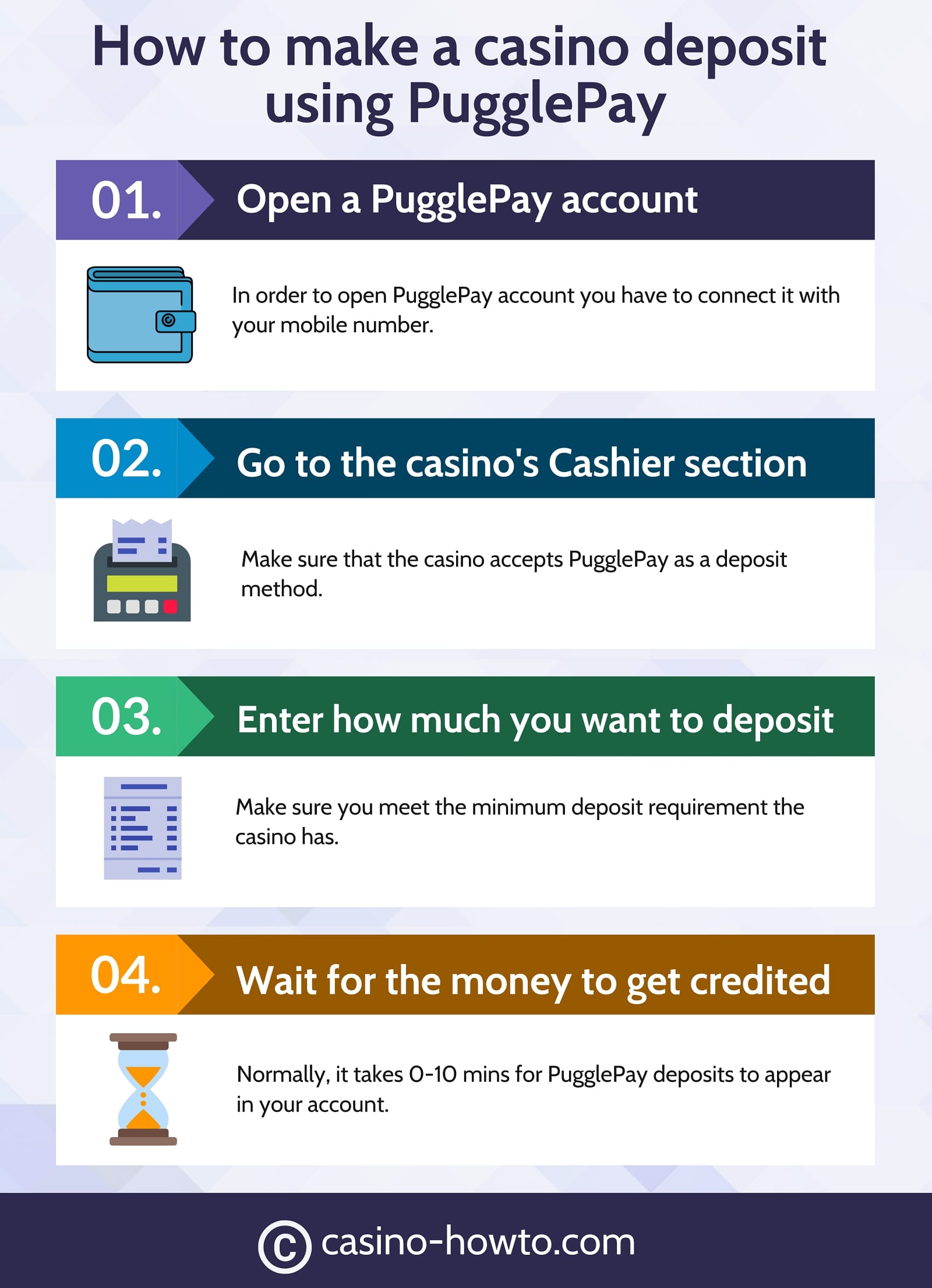
The deposit process worked roughly like this:
Select PugglePay in the casino cashier. The casino needed an active integration with the service.
Enter the deposit amount. The casino could apply its own minimum and maximum limits. There was no sensible universal casino limit that applied to every operator.
Enter your mobile number. This was central to the PugglePay payment flow and was used to identify and contact the customer.
Confirm the SMS code. A verification code sent to the phone was entered into the payment screen.
Pass the payment check. PugglePay could assess whether the invoice-based payment would be approved.
Receive the casino balance. Approved deposits were generally credited immediately rather than waiting for the invoice to be paid.
Pay the invoice later. Historical versions of the service gave customers a period in which to settle the amount, commonly around 14 days.
That last point is what made PugglePay controversial from a gambling perspective. The player could gamble money before actually paying the invoice. I think that is a poor structure for anyone who struggles with gambling budgets, because it separates the act of depositing from the moment money leaves your available cash.
Limits varied by casino and by whatever credit or payment checks were applied. I would not trust modern websites quoting one fixed PugglePay maximum because the method no longer operates as a standalone current service.
The practical solution for players today is simple: if PugglePay appears on an old casino article but not in the cashier, choose an active payment method instead.
Why PugglePay Was Not A Normal Withdrawal Method
Historical PugglePay was built primarily for making invoice-based payments, not for receiving casino winnings. That meant players could deposit through PugglePay but generally needed another route for withdrawals.
The normal process was therefore:
- Request the withdrawal at the casino.
- Choose an available alternative such as bank transfer or an e-wallet.
- Complete casino KYC if required.
- Wait for internal casino approval.
- Receive the payout through the alternative payment service.
There was no meaningful PugglePay withdrawal limit per transaction because PugglePay itself was not the payout method. The limit came from whichever alternative the casino used.
This is one of the biggest weaknesses I see in the old system. A deposit-only method makes the cashier less predictable because money travels in one way and winnings come back another.
Today, I would not select a casino specifically because it has an old association with PugglePay. I would choose one that supports a current two-way method instead.
What Happened To PugglePay Casino Bonuses
PugglePay deposits historically appeared alongside the same welcome offers and ongoing promotions available through other casino payment methods. Whether a deposit qualified depended on the individual operator rather than PugglePay itself.
Players could encounter promotions such as:
- Welcome bonuses on the first qualifying casino deposit.
- Reload offers for later deposits.
- Cashback based on qualifying losses.
- VIP programs offering points or account benefits.
- Slot races tied to eligible wagering.
- Tournaments on selected casino games.
- Free spins attached to deposit offers.
- Bonus stores using loyalty points or other casino rewards.
The invoice model did introduce an unusual problem. A bonus could encourage a larger deposit even though the player had not yet paid the underlying invoice. In my view, combining gambling promotions with deferred payment is not a particularly player-friendly setup.
For current players, any PugglePay bonus page should be treated as historical unless the casino can prove the payment route is still active. I would never deposit through a different method merely because an old page promises a PugglePay-specific offer.
Bonus terms also change frequently. Payment eligibility, wagering requirements and minimum deposits should all be checked in the current promotion rather than an archived casino guide.
What PugglePay Got Right And What Made It Risky
PugglePay had some genuinely useful ideas, especially at a time when mobile casino payments were less polished than they are now. Its weaknesses were significant though, particularly because gambling and delayed payment are not a great combination.
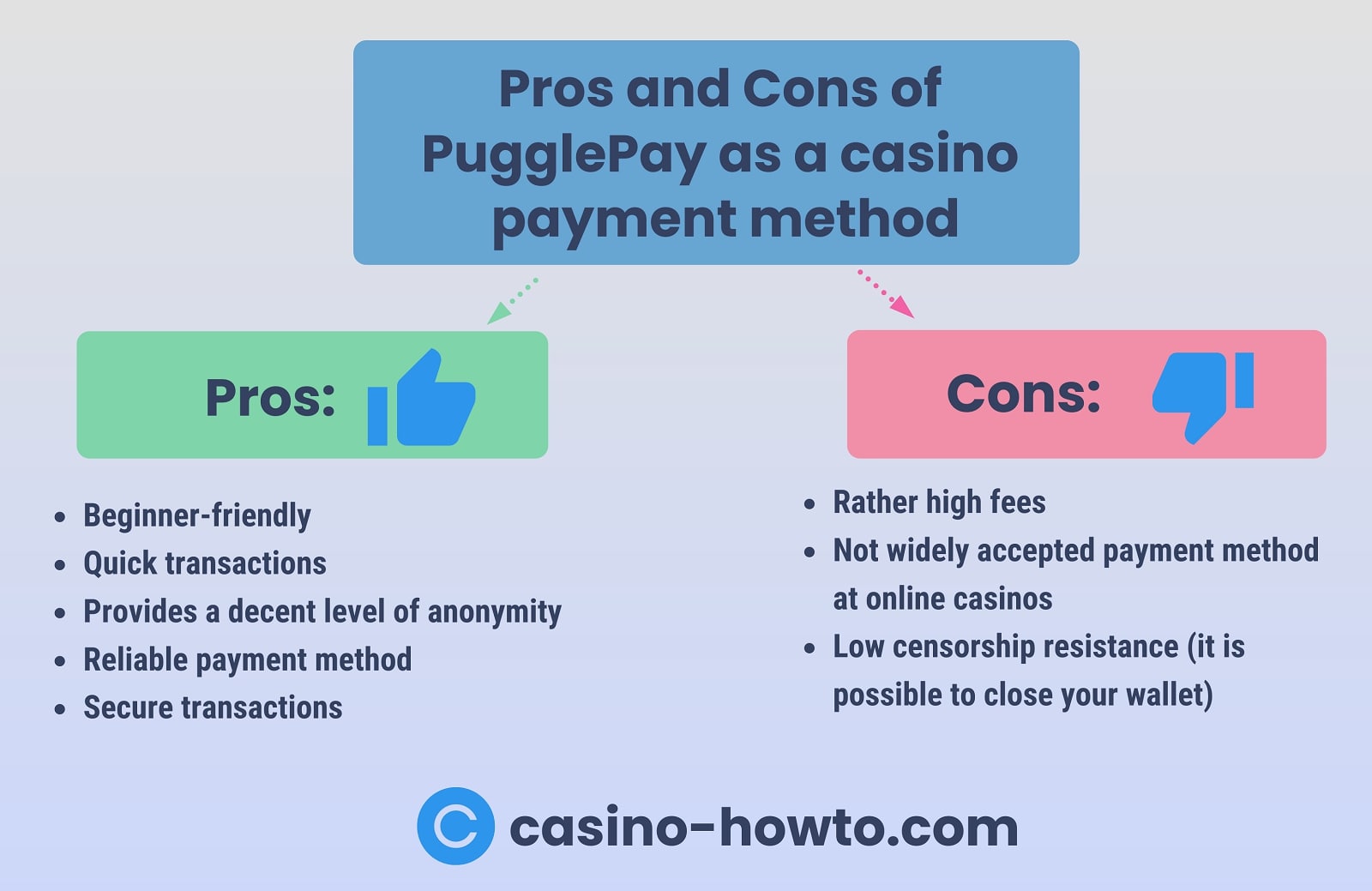
Advantages
Deposits were fast. Approved PugglePay payments could credit a casino account straight away. Players did not need to wait for an ordinary bank transfer.
No card details had to be entered at the casino. The payment relied heavily on the player's mobile number and payment verification, which reduced the amount of card information shared with gambling sites.
It was designed around mobile use. The SMS-based process suited casino players using smartphones and was relatively simple compared with many payment systems of the period.
No traditional e-wallet balance was required. Players did not have to preload a separate wallet before depositing.
The invoice was separate from the phone bill. PugglePay payments were not simply buried inside a monthly mobile-phone charge, making the amount owed easier to identify.
Disadvantages
It allowed deferred gambling payments. This is the biggest problem in my view. Gambling on an amount that you have not yet paid can make losses feel less immediate and encourages spending money that may not actually be available.
Late payment could become expensive. Missing an invoice deadline could lead to reminder charges, interest or collection procedures depending on the applicable terms.
Withdrawals were not supported in the same way. Players needed another payment option for cashing out.
It was geographically limited. The service was particularly associated with Sweden and parts of the Nordic market rather than being a widely available international method.
The standalone service no longer exists. This is now the decisive disadvantage. Players cannot reasonably choose PugglePay as a normal current casino cashier method.
Old casino pages can be misleading. Search results still contain casinos and affiliate pages describing PugglePay as though it were active, which makes checking the live cashier essential.
How PugglePay Verification Used To Work
PugglePay relied heavily on the user's mobile phone for the payment process. The customer entered a phone number and received an SMS code that had to be confirmed before the payment could continue.
The provider also developed methods for identifying the owner of a phone number, which added another layer to payment checks. This still did not replace casino KYC.
A casino could separately ask for a passport, national identity card, proof of address or payment-related evidence before processing winnings. I would consider that normal at a properly regulated operator.
If an old PugglePay transaction ever needs to be documented, useful evidence could include an old invoice, transaction confirmation, casino cashier record or correspondence linked to the payment. Players should not send unrelated personal records when only one transaction needs checking.
One security rule remains simple: no casino should ask for passwords or unrelated authentication credentials just to prove an old PugglePay deposit. Verification should be limited to information needed to connect the transaction with the account holder.
Problems Players Can Have With PugglePay Listings Today
The main issues now come from outdated information rather than the payment process itself.
PugglePay appears on a casino review but not in the cashier. The review is probably old. Check the live payment page and use a current method instead.
A casino claims PugglePay still works. Ask support exactly who processes the payment. If they cannot explain it, I would not send money.
PugglePay is confused with Zimpler. The two names belong to the same company's history, but the present Zimpler payment system is not the old PugglePay invoice product.
An old withdrawal guide says PugglePay payouts are available. Historical PugglePay was not a standard casino withdrawal service, so treat that claim cautiously.
Old fee information is shown as current. Late-payment charges and invoice terms from historical PugglePay products should not be presented as active 2026 fees.
A bonus page still lists PugglePay. Confirm the promotion in the active casino terms before depositing through any alternative.
A casino still uses an old payment logo. Outdated banking information makes me question how carefully the rest of the site is maintained as well.
Safety Concerns Were Bigger Than Just Payment Security
PugglePay's mobile confirmation process reduced the need to hand card details directly to a casino, which was a useful security feature. The more serious concern was financial rather than technical: players were able to create a gambling deposit and pay for it afterwards.
I do not think gambling on invoice is a good payment structure for most players. Depositing from money already present in a bank account or wallet makes the financial effect clearer at the moment the decision is made.
Late-payment consequences also matter. A gambling loss is already gone at the casino, but an unpaid invoice can create another financial problem afterwards through charges or debt collection.
Today there is another security concern: fake or outdated PugglePay branding. Because the name is no longer a normal active payment service, I would be very careful with any site asking players to submit personal or financial details through a supposed new PugglePay portal.
Use current licensed payment providers and access them through the casino's verified cashier. I would never follow an unsolicited message claiming that an old PugglePay account needs to be reactivated.
Current Alternatives Make More Sense Than PugglePay
Since PugglePay itself is no longer the practical choice, players have several active alternatives.
Zimpler: The clearest successor because PugglePay developed into the company now operating under the Zimpler brand. Modern Zimpler focuses on bank-connected digital payments rather than the old invoice setup.
Trustly: A direct bank-payment method with strong recognition at Nordic casinos. It can support both deposits and payouts at participating operators.
Brite: Another account-to-account payment option that can work well for players who prefer direct banking.
Skrill: An established casino e-wallet supporting deposits and withdrawals at many international sites.
Neteller: Similar to Skrill and still useful where a casino supports two-way wallet payments.
MuchBetter: A mobile-focused payment service available at selected gambling sites.
Visa or Mastercard: Straightforward for deposits where gambling card transactions are permitted, although withdrawal options differ.
Regular bank transfer: Less glamorous but useful for withdrawals and larger transactions, particularly when speed is not essential.
PugglePay Casino FAQ
Do All Online Casinos Accept PugglePay? No. More importantly, PugglePay is no longer a normal standalone payment service, so I would not expect legitimate current casinos to offer the original PugglePay payment product in 2026. Some old casino pages and directories still contain the name.
How Long Does A PugglePay Deposit Or Withdrawal Usually Take? Historical PugglePay deposits were generally credited immediately after approval. Direct PugglePay casino withdrawals were not normally supported, so winnings had to be paid through another method and the timing depended on that alternative.
Are There Mobile PugglePay Casinos? PugglePay itself was designed around mobile payments, and the casinos in older PugglePay ratings were commonly mobile friendly. For current players, the relevant point is that modern alternatives such as Zimpler and instant banking are also designed to work well from smartphones.
Can I Receive Bonuses For PugglePay Deposits? Historically, yes, where the casino's promotion allowed PugglePay deposits. Current bonus pages mentioning PugglePay should be checked carefully because the payment service itself is no longer active under that standalone name.
How Much Can I Deposit Using PugglePay? There is no current PugglePay casino deposit limit because the standalone service is no longer offered. Historically, limits depended on the casino and the payment approval applied to the individual transaction.
Are There Any Fees For PugglePay Deposits? Historical costs depended heavily on invoice terms. Paying on time could keep costs low, while overdue invoices could result in reminder charges and interest. Those old terms should not be confused with current Zimpler fees.
Is PugglePay The Same As Zimpler? PugglePay was the original service and company name that later became Zimpler, but I would not call the payment products identical. Zimpler's current bank-payment model is substantially different from PugglePay's old invoice-based casino deposit system.
Can I Still Find A Real PugglePay Casino In 2026? I would not expect to find the original standalone service operating at a legitimate current casino. If a site says otherwise, I recommend asking exactly which licensed payment company is processing the transaction before entering any personal details.
Why I Would Choose A Modern Alternative Now
PugglePay played an interesting part in the development of Nordic mobile casino payments. Its phone-based confirmation was convenient, deposits were fast and players did not have to submit card details directly to the casino.
The invoice system is the part I like much less. Letting someone gamble first and pay later creates unnecessary financial risk, and PugglePay also lacked the clean two-way payment flow I prefer because winnings needed another withdrawal method.
Today, though, the decision is much easier. The original PugglePay product has been replaced and the company moved forward under the Zimpler name. PugglePay is therefore more useful as a historical payment-method term than a casino feature players should actively search for.
I would not choose a casino because an old page says it accepts PugglePay. I would choose a properly licensed operator offering a current bank or wallet method with fast deposits, straightforward withdrawals and no unnecessary casino fees.
For players who liked the mobile simplicity behind PugglePay, modern instant-banking services provide a much better solution without relying on an obsolete invoice product.